

Soil Testing Questions Delay Decision on Subdivision Near Southwest Harbor Landfill


The Bar Harbor Story is generously sponsored by the Maine Seacoast Mission.

SOUTHWEST HARBOR—The ultimate fate of a subdivision by a Southwest Harbor landfill is still up in the air, though its difficulties remain firmly rooted in soil.
The town planning board ventured back into the discussion of the conditionally approved 12-lot Trundy Farm Subdivision, which is by the six-acre Worcester Landfill off the Long Pond Road in Southwest Harbor, November 18, as it received soil sampling results from Haley Ward, Inc.
The final approval has been delayed as some members questioned the methodology of the samples and if the testing complied to state standards for locations near landfills. In the end, a split board voted to postpone the decision until its December 2 meeting. Chair Eric Davis, Charlotte Gill, Priscilla Ksionzyk, and Joel Wolak voted in favor of postponement, John Williams voted against it.
The samples, collected October 3, were the final part of the approval process for the subdivision.
Pollution from the landfill has been found in groundwater east and south of the site. The landfill has existed for almost 100 years. It was last used in the 1990s.
Gill said of the two-week postponement, “I hate to do it, but I propose we move it out to the next meeting to make a decision on it, because I think this really needs, in light of this information, we should look at and make sure he’s satisfying what the state is asking for, for landfill adjacent sites. And if we are, I have no problem with signing. I just want to make sure that that’s what we’re doing.”
One of the things that she’s trying to find is if the soil sampling depth, which maxed out at six inches, and other methodology was up to state standards.
“I’m not questioning his work. I’m asking for copies of paperwork of what the state says he should have done. I don’t think that’s being unreasonable,” Ksionzyk added.
The women agreed that they wanted to make sure that it was the right soil test done for this sort of property.
“I want an informed decision, and I want to be able to make an informed decision, and I can’t make an informed decision,” Gill said.
Other planning board members worried that it was an additional burden on the applicant.
The proposed subdivision is owned by Ben “Lee” Worcester, who is also the planning board’s vice chair. He recused himself from the discussion. Member Mike Levesque also stepped down from the conversation because he lives closeby.
Worcester’s family owns Eastern Maine Recycling, which is a local transfer station. The family also owns the landfill on Long Pond Road, which is being monitored by the Maine Department of Environmental Protection. The subdivision is near both the Eastern Maine Recycling (EMR) facility and the Worcester landfill site.
The planning board’s conditional approval in October came after a previous split vote about evaluating the soil on the property.
“Haley Ward,” according to its website, “is a technical consulting firm, offering a range of engineering, environmental and surveying services focused upon delivering client-based solutions.”
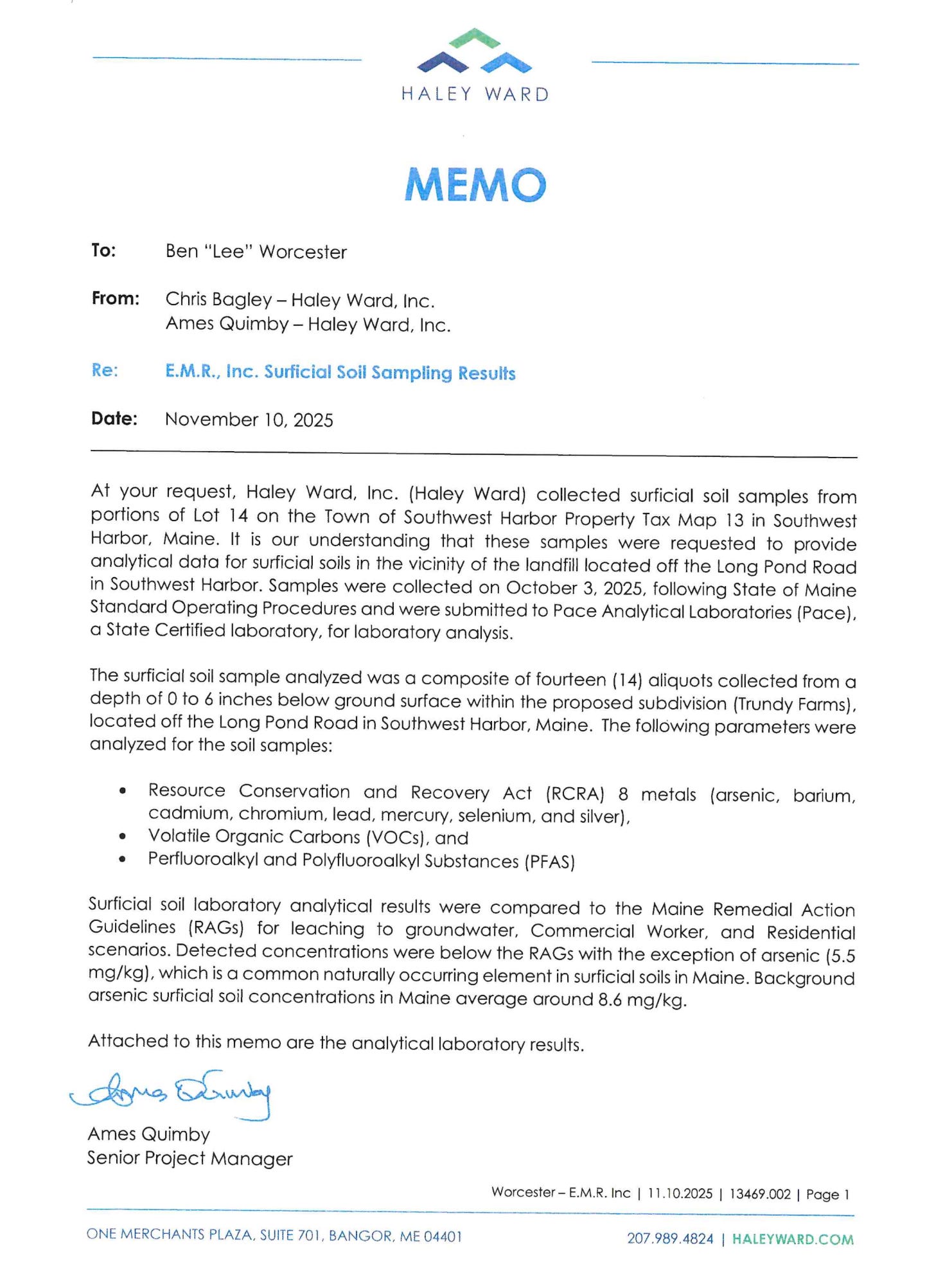
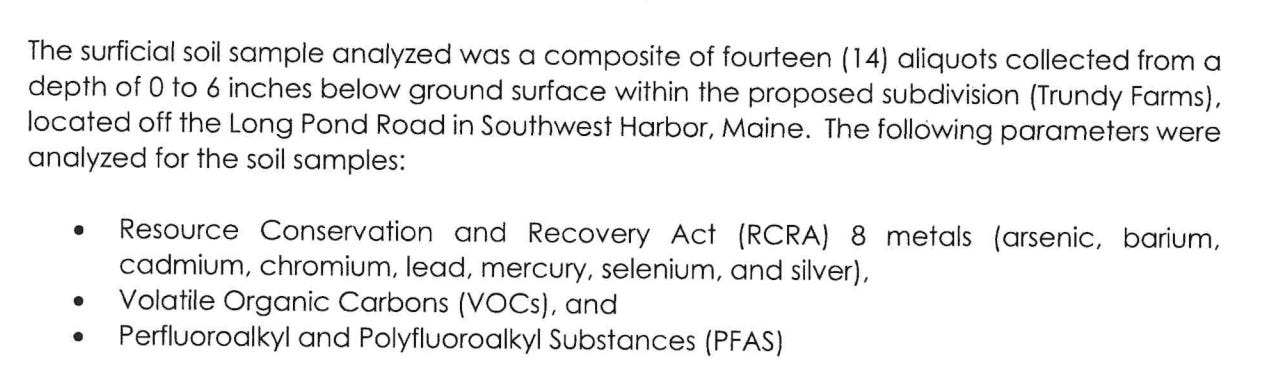
According to the Haley Ward document, the company took soil samples from part of lot 14 (lot 14 includes the subdivision) for analytical data for surficial soils. The group took fourteen aliquots from depths that varied between 0 to 6 inches below the ground’s surface.
Dictionaries define surficial as meaning “surface.” The State of Maine’s Geological Survey site defines it as “sediments such as clay, silt, sand, gravel, and other loose deposits which lie on top of bedrock are grouped together in the general category of surficial materials. These materials are not soils; they are the deeper earth materials that lie between the soil zone and the underlying bedrock. Soils commonly develop by weathering of the uppermost part of these materials.”
Some board members and members of the public questioned where the samples had been taken.
“They were taken all over the place,” Worcester said when asked where the sites were on the lot.
Haley Ward looked to arsenic, barium, cadmium, chromium, lead, mercury, selenium, silver, volatile organic carbons (VOCs) and perfluoroalkyl and polyfluoroakyl (PFAS) levels.
The Haley Ward representative wrote that they only found arsenic (5.5mg/kg) above the accepted level. They added that arsenic surficial soil concentrations in Maine average at approximately 8.6 mg/kg.
Opponents of the project who have worried about the project’s location close to the landfill and potential health and environmental impacts, submitted via former select board member James Vallette, a rebuttal, which was not included in the online planning board packet at the time of the meeting.
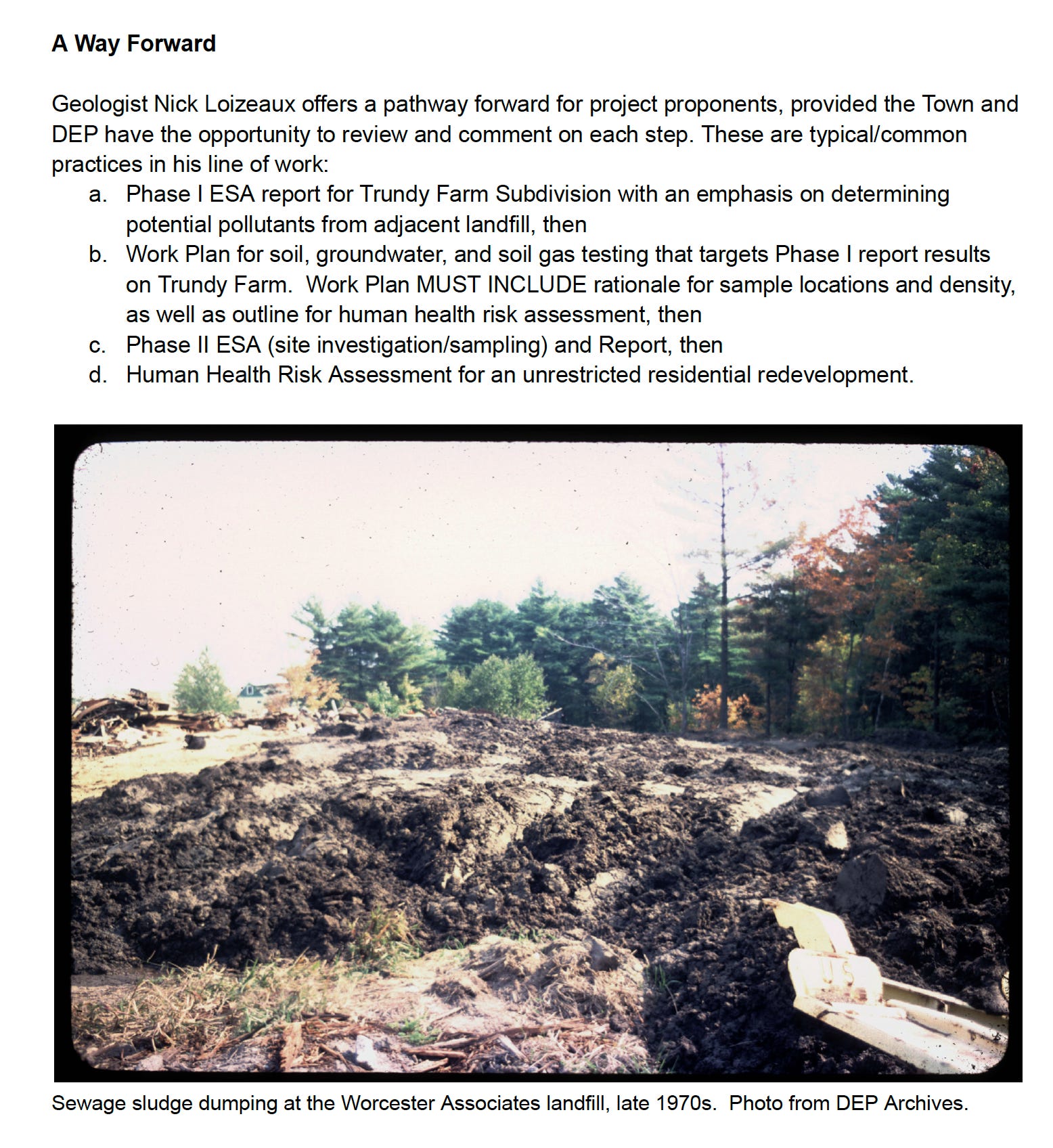
According to Vallette’s document, two local geologists, Nick Loizeaux and Doug Rissing, had reviewed Haley Ward’s report and found it lacking because there was no map of where the samples were taken, the samples didn’t correspond with state standards of uncontrolled sites, and methane was not tested.
“Haley Ward did not consider other migration pathways to potential residential receptors on the subject property,” Vallette wrote, “The testing procedures do not correspond with standard protocols for testing soils at contaminated sites that are proposed for unrestricted residential developments.”
“It seems to me that sampling to a depth of 6 inches is an obvious attempt to get around the will of the people of Southwest Harbor who have voted to ensure the environmental remediation is done properly and in good faith,” Rissing is quoted as saying in Vallette’s document.
Loizeaux was equally damning in the Vallette document, “The 11/10/25 Haley Ward Memorandum is grossly insufficient for the Southwest Harbor Planning Board to approve the Trundy Farm residential subdivision adjacent to the former Worcester Landfill.”
At the meeting, Vallette said that the new information should be subject to public revue and comment. The board refused. There was, however, a few back-and-forth exchanges between Vallette and the board.
Those exchanges included whether or not the public should be able to comment on new information submitted in the application (the Haley Ward document), wanting to know where the locations were that were soil tested, and where the boundaries of an “uncontrolled site” might be, and questioning whether a leachate ditch crossing the parcel was part of the landfill structure.
A citizens’ initiative that called for testing of soil contaminants for any property within a half-mile of anywhere the state has deemed “an uncontrolled site” prior to any land use that requires permitting, passed resoundingly 554-187.
Tremont Code Enforcement Officer Angela Chamberlain was sitting at the planning board table during the meeting and taking minutes. The town has advertised for a part-time position to take minutes at its planning board and appeals board meetings.
LINKS TO LEARN MORE
The packet of materials including the full Haley Ward document.
To listen to the meeting, click here.
The PDF below is Vallette’s review that was sent to planning board members.

HELP SUPPORT THE BAR HARBOR STORY
Thank you so much for being here with us.
We keep our news free because news should never be out of reach, but every one of our stories take time to write, and your support keeps The Bar Harbor Story going.
If you value our work, please consider a paid subscription, a founding membership, or a sponsorship.
Even $5 a month makes a difference. Or click here to become a one-time supporter now.
Founding member information can be found here.
Have questions about sponsorships? Just send Shaun an email at sfarrar86@gmail.com, he’d love to hear from you.